Monthly Archives: March 2026

March 1, 2026

By David Snowball

Dear friends, welcome to the March, beginning of spring, greening of the year, edition of the Mutual Fund Observer. We’re glad you’re here.

Every semester, I am reminded that the jeremiads are wrong.

In this case, they’re the thousand casual, caustic dismissals of the generation now sitting in college classrooms: addled, self-absorbed, screen-enslaved, and lost, we’re told. I have heard the charges. I have read the research. I worry about the kids.

Then I walk into the room with them, and the story changes.

This week, the question in Comm 370, my Comm & Emerging Technologies class, was one that I’d heard before but that has become sharper lately: Are we doomed?

She wasn’t being theatrical. She had been reading about technological affordance and neuroplasticity, the way a technology quietly reshapes not just our behavior but our brains, bending us toward whatever it makes easiest until the bend becomes permanent. She had been thinking about path dependence, about decisions made casually that turn out to have no exit. The research on our increasing dependence on AI didn’t help.

It was a good question. I wish I had a better answer.

What I had was this: “It depends on what you choose. It depends on what we choose. And our most important choices begin with the word ‘no.’ As in, ‘No, I’m not doing it just because everyone else is. No, I’m not responding to boredom or stress by sinking into a digital world. No, I’m not setting down a book because my laptop and its 27 tabs are easier.’ Because if you don’t learn to say ‘no’ now when it’s easy, and the stakes are small, you never will.”

“No” is also the first word spoken by the world’s most courageous people. 

And then, because the universe occasionally provides, I had an unlikely illustration: a guy who looks like he wandered off a Seinfeld set where he played the comic book shop owner but who co-founded and runs Anthropic, a company that builds artificial intelligence, who was handed an ultimatum by Secretary Hegseth, and who said, simply and quietly: “No.”

Dario Amodei. I’m sure his exact words to Secretary Hegseth were more measured, and yet their effects, and the courage they took, were quite the same. Mr. Amodei is responsible for an AI known as Claude, the most personable and likely most talented creature of his kind. The core principle for Amodei and his fellowship is both hopeful and clear-eyed: “At Anthropic, we build AI to serve humanity’s long-term well-being.” They have both created and compromised a “framework for managing catastrophic risks from advanced AI systems.” And because life is complicated and choices are hard, that same week, Anthropic quietly revised its own safety commitments, abandoning a hard pledge never to train more capable AI without proven safeguards in place. The reason was honest if uncomfortable: unilateral restraint in a race benefits only those with no restraint.

‍Two demands made by the self-styled Secretary of War (legally, he is still Secretary of Defense, but a September 2025 Executive Order allowed him to call himself, and his department, “of War,” a title that carries the same legal weight as Leonardo diCaprio’s declaration from the prow of the Titanic, “I am king of the world!”) and rejected by Amodei. The demands were that Claude be allowed to be used for “the mass domestic surveillance of Americans and fully autonomous weapons” (Anthropic statement, 2/27/2026) … or else.

Mr. Amodei did the quietly remarkable. He said “no.” He did not preen, did not strut for the cameras, did not howl through the night on social media, did not carefully adjust his makeup before threatening “to make an example” of those who dared challenge him. He simply said “no,” and went home.

That day, the administration orchestrated a punishment campaign against Anthropic, declaring them to be a national security risk, ending their government contracts, and beginning inquiries into the use of Claude by any government contractor. A day later, Mr. Hegseth oversaw an attack on a sovereign nation and the assassination of their theocratic leader. And Claude surged to become the most downloaded app from the Apple Store, breaking all-time records every day that week. It climbed rapidly in the rankings, moving from outside the top 100 to No. 1 by the end of February.

I think that the American people just said, “No.”

I’ll let my kids know.

In this month’s Observer …

Our colleague Lynn Bolin shares Hope Is Not a Good Strategy, Lynn’s periodic reminder that markets have memory even when investors don’t. Drawing on a recent history of American finance, he maps the inflation-adjusted returns of the S&P 500 across ten periods since 1929 and arrives at a sobering conclusion: the exceptional gains most investors treat as normal clustered in just two eras, neither of which describes today’s market. His counsel is not panic but preparation — modest cash reserves, genuine downside protection, and resistance to the comfortable assumption that the last three years represent a new normal rather than the late innings of a cyclical bull.

Perpetual Income for Dummies, also by Lynn, answers a friend’s request for a simple, durable portfolio that generates steady withdrawals, keeps pace with inflation, and survives both recessions and rising rates without requiring its owner to be a professional. His solution outperforms Vanguard Wellesley Income over ten years while maintaining lower drawdowns — not by taking more risk, but by diversifying the sources of income so that interest-rate sensitivity and recession sensitivity partly offset each other. A portfolio you can actually live with, in both senses of the phrase.

In New Year’s Resolution #2: Don’t Underwrite Yachts, I raise two possibilities: (1) the term “crazy-rich” has gotten entirely too literal lately and (2) you do have options, though not frictionless ones, for stepping back and reasserting a degree of balance … at least in the sliver of the world you have control over.

Extraordinary times (aka “now”) call for extraordinary thoughtfulness. In Building the Insulated Portfolio, we use the extraordinary tools available through MFO Premium to answer the question: Are these funds earning their spot in a risk-conscious portfolio? Good news: 80% are. Other news: two promising funds have turned consistently south, measured by both robust returns and downside resilience. Chip has rolled out the chopping block.

The folks at Disciplined Growth Investors run a consistently strong balanced fund. In late February, they launched a second fund, Disciplined Growth Investors Equity Fund, that (a) is a conversion of a long-running limited partnership and (b) embodies just the equity sleeve of the DGI flagship fund. It’s an interesting old-school product.

And, as always, The Shadow shares the record of the investment industry’s most recent twists, turns, and twerks, in Briefly Noted. That includes a fairly consequential piece on the renaissance of Matthews Asia, a good group that seems unwilling to settle for half-measures.

Investing in a Fragile World

“Yeah, there is one thing. My own morality. My own mind. It’s the only thing that can stop me.” — Donald Trump, interview with The New York Times, January 8, 2026, when asked about the limits of his power

Something structural has changed, and the standard playbook hasn’t caught up.

For three decades, the sensible strategy was reassuringly simple: buy broad U.S. index funds, hold them through turbulence, and trust that institutional stability would eventually reward patience. That strategy worked because the underlying assumptions held: falling interest rates, benign inflation, American hegemony as the organizing principle of global commerce, and a rules-based international order that, however imperfect, constrained the worst impulses of powerful actors.

Those assumptions are now in question simultaneously.

Ray Dalio describes a late-stage breakdown of the long-term debt cycle compounded by eroding geopolitical order. Mohamed el-Erian sees structural fragility masked by surface calm, a world where shocks arrive more frequently, and the shock-absorbing infrastructure is itself weakening. Oaktree’s Howard Marks (Memo, 10/2023) calls it a “sea change.” They’re describing the same thing from different angles: we’ve left one regime and entered another, and the transition is neither smooth nor brief.

Mr. Marks’ November 2025 memo revisiting the psychology of risk cycles, put it plainly: the worst decisions are made in the best of times, when the possibility of loss has “receded from consciousness” and missing out on gains feels more dangerous than losing capital. That description fits 2025’s speculative surge with uncomfortable precision.

For prudent investors, this creates a specific problem. Broad U.S. index funds now concentrate enormous bets in a handful of companies whose valuations assume a very particular, very optimistic future. When the S&P 500’s top five holdings exceed 25% of total market value, “the market” is not the diversified instrument it once was.

The repositioning that makes sense in this environment isn’t panic. It’s recalibration toward what has always worked in harder times: quality companies purchased at reasonable prices, genuine geographic diversification, a serious consideration of assets beyond equities, and reduced dependence on the continued ascent of American stocks that are already priced for perfection.

Ruchir Sharma noted recently in the Financial Times that quality stocks just suffered one of their worst relative declines in decades … and historically, such periods have preceded their strongest returns. The case for patient, quality-oriented investing isn’t new. In a fragile world, it’s simply more urgent (“The best time to buy quality stocks is now: A generational opportunity in otherwise bubbly markets,” Financial Times, November 30, 2025).

The investors who will fare best aren’t those who predicted the fragility. They’re those who built portfolios that don’t require stability to generate acceptable returns.

Thinking in a fragile world

In our “yachts” essay this month, we address the cost of frictionless transactions, ones that are so easy that they become no-brainers. Literally. One more “buy now,” then back to work. One more upload to Instagram. One more minute scanning before I get back to work … I mean it this time.

Those of us who teach and research about such phenomena use terms like “technological affordance” as we explain what makes the slippery slope slippery. The widespread spread of generative AI makes the challenge greater since helpful, amiable (some say “sycophantic”) AI call you like the Sirens of Greek myth. The term in circulation is “cognitive offloading,” letting the AI do the thinking (and writing) for you.

But there is another model: a partnership that leads to “cognitive augmentation.” It’s a collaborative approach in which a human, deeply investing in whatever they’re doing or writing about, has a fairly disciplined partner to whom they can turn and ask, “What am I missing here? Is there a voice that I’m not attending to? Are my arguments stumbling over one another?” Excessive deference is not an intrinsic element of an AI persona; it’s a default that can be talked away. (Claude has, and attends to, very clear instructions about my desires on the subject.) That’s a harder model, one that builds friction into the system; that is, it’s designed to make things slower, harder, more deliberate … and better (Alexandra Pattillo, “Can ‘friction-maxxing’ fix your focus?” BBC.com, 2/27/2026).

Howard Marks, it turns out, arrived at the same conclusion independently. He begins his most recent Memo (The AI Hurdle Ahead, 2/26/2026) with a reflection on Claude, collaboration, friction, and the ability to be surprised.

I recently returned to [some interesting techies in their thirties and forties] to follow up on my December memo (“Is It a Bubble?”). As part of that process, someone suggested I ask Claude, Anthropic’s AI model, to create a tutorial explaining artificial intelligence and the changes that have taken place in the last three months. I did so, and it gave me a great deal to work with. This resulting memo is intended as an addendum to December’s. Much of it will recap Claude’s 10,000-word essay, to which I’ll add a few observations of my own. In the process, I’ll highlight some terms that were new to me and might be new to you. I could have saved myself a lot of time by asking Claude to write this memo, but I decided not to, because I consider putting words on paper a big part of the fun. I will, however, quote liberally from Claude’s work product. That’ll be the source of all quotations that aren’t otherwise identified.

Before I start in, I want to try to communicate the level of awe with which I viewed Claude’s output. It read like a personal note from a friend or colleague. It made reference to things I’ve talked about in past memos, like the sea change in interest rates and the pendulum of investor psychology, and it used them in metaphors related to AI. It argued logically, anticipated points I might make in response, injected humor, and bolstered its credibility by candidly acknowledging AI’s limitations, just as I might do. I’ve asked AI questions before and gotten answers back, but I’ve never received a personalized explanation like I did in this case.

The people who will fare best in the decade ahead, the grown-ups, aren’t those who denounce AI nor those who treat it as the latest frictionless shortcut. They’re those who understand that the best relationships – parental, marital, intellectual  – are built on friction, on the sometimes difficult, often joyful work of thinking together.

The etymology that I couldn’t afford to mention above

Part of the reason MFO takes so long to compose is that there are so many sights to stop and see along the way, many of which I dasn’t share. (Cool word, “dares not,” Middle English, beloved of the Pennsylvania Dutch.) The one I dasn’t add to this month’s intro is that “no,” like “brother” or “father,” is one of our most ancient words, emerging over 6,000 years ago, making its adamant way almost unchanged into almost every European language, a concept so central and so universal that it brooks no alteration.

PS, Chip reports that “no” is generally the first word spoken by toddlers, the world’s most independent creatures.

Thanks, as ever …

To The Faithful Few whose monthly support keeps the lights on and supports up: Gregory, William, William, Brian, David, Doug, Altaf, and the good folks at S & F Investment Advisors. Thanks also to David from Vail, Radley from Cupertino, Thomas from Williamsburg, RHG Advisors, Wayne, and the Vaidya Family Fund, who all added to our support in the past month. We appreciate you all!

Despite a name honoring Mars, the god of war, we wish you a peaceful month and joyful greening of your garden.

Back soon!

david's signature

Building toward an insulated portfolio

By David Snowball

Investing is always an uncertain project, generally undertaken in uncertain times, building with uncertain tools. It’s great if you own shares in Xanax’s parent, Pfizer, but frequently miserable otherwise.

Three factors make the current market a source of epic uncertainty: valuations are historically high, concentration is historically high, and safeguards are historically weak. Let’s agree that by “historically” we mean something like “since modern civilization nearly ended withthe Great Depression,” so about 100 years.

Valuations are historically high.

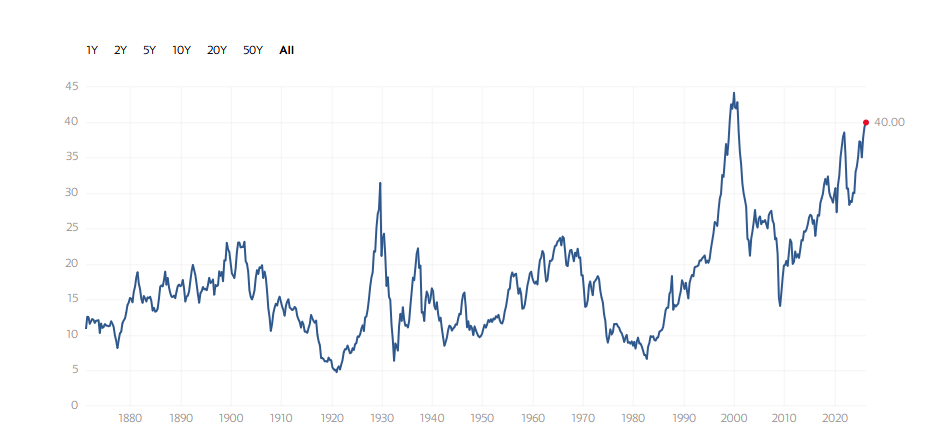
The Shiller CAPE P/E attempts to reduce noise in the earnings data, which can easily create transient false valuation signals, by looking at average inflation-adjusted earnings from the previous 10 years rather than, say, the previous three months. So the current Shiller CAPE translates to “assuming the earnings over the past 10 years are pretty representative of the economy today, how much are you paying for each dollar of earnings?”

Short version: a lot. Currently, broad market investors are paying $40 to buy $1 in earnings, the second-highest price for stocks in 150 years.

Source: Shiller PE Ratio, February 2026, per multipl.com.

Stock market concentration is historically high.

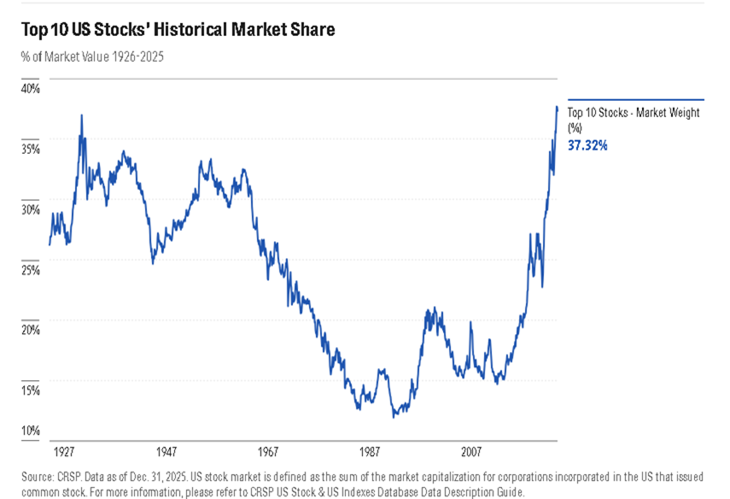
Morningstar’s Dan Lefkovitz notes that “Stock Market Concentration Has Surpassed Its 1930s” (2/27/2026). That’s true by at least two measures.

First, the 10 largest US stocks comprise 37% of the total value of the market, the highest weight in history.

Source: Morningstar.com

Second, sector concentration has also spiked. The tech sector is 34% of the S&P 500, higher than it was during the bubble years of the 1990s. The second largest sector, financials (12%), carries barely one-third of the heft.

Mr. Lefkovitz reports on both sides of Morningstar’s research on the question. One side: “Concentration can be great for returns when market leaders are rallying” (Bold Portfolios: Are They Worth Their Risks?, a 2026 Morningstar UK report on concentrated funds, not concentrated markets). But, he notes, “there’s a flip side. ‘Even if concentration doesn’t guarantee a downturn, it erodes diversification benefits and makes markets more vulnerable to sentiment reversals,’ according to the Morningstar Outlook” (“Stock Market Concentration Has Surpassed Its 1930s,” 2/27/2026).

Investor safeguards are historically weak

U.S. investors today face not just historic valuations and concentration, but historically weak protection: the instruments are fuzzier, the guardrails lower, and the payoff to bad behavior higher. The federal statistical system has been hollowed out by budget and staffing cuts, yielding larger revisions and patchier coverage in core data like jobs and inflation, so both the Fed and markets are “driving through fog.” At the same time, federal financial enforcement, especially at the SEC, has retreated from post‑crisis norms in both case counts and penalties, while fraud surveys and complaint data show rising incidence and sharply higher realized losses. In practice, more of the burden falls on individual investors to detect risk that used to be constrained by stronger data and enforcement. That doesn’t dictate where markets go next, but it does make a clear‑eyed, portfolio‑by‑portfolio review less a luxury and more a basic act of self‑defense.

Converting awareness into motivation for an insulated portfolio

An insulated portfolio isn’t risk-free, but it’s conscious of exceptional risks. In the normal course of events, an investor knows how many high-beta funds or ETFs they hold. In the abnormal course of events, an additional layer of analysis might help.

We used the tools at MFO Premium to look carefully for hidden risks in my portfolio. That took place in three steps.

First, we looked at our funds’ intercorrelations. This is a six-year analysis, since that’s the age of the youngest fund in the portfolio. A correlation of 1.0 means two funds move in perfect lockstep; 0.0 means they move in perfect independence. For my purposes, correlations of about .80 warrant attention as potentially too high, and correlations below 0.5 signal reassuring independence. Negative correlations signal that one fund tends to rise when the other one falls.

Six-year fund correlations, through January 2026

  BAFWX SIGIX FPACX GPMCX PVCMX RPHIX SWVXX RSIIX LCORX SIVLX
Brown Adv Sust Gr 1.0 .38 .73 .61 .27 .68 .24 .60 .66 .25
Seafarer G&I   1.0 .67 .71 .63 .11 -.32 .29 .58 .91
FPA Crescent     1.0 .75 .61 .31 -.02 .66 .85 .61
Grandeur Global Micro       1.0 .66 .45 .06 .51 .72 .61
Palm Valley         1.0 .27 .06 .54 .62 .50
RiverPark Short Term           1.0 .44 .45 .27 .01
Schwab MM             1.0 .22 .04 -.40
RiverPark Strategic               1.0 .55 .31
Leuthold Core                 1.0 .48
Seafarer Value                   1.0

Good news: there is only one high correlation in the entire matrix. FPA Crescent and Leuthold Core, both flexible portfolio funds, have an 85% correlation. No one else is above 80. Twenty-one of the correlations are at or below 50%. What that means is that all of the funds in the portfolio are making distinct contributions; no two funds are bringing the same set of strengths and weaknesses to the table.

Second, we looked at our funds’ correlation with both the S&P 500, a surrogate for an overpriced stock market, and an ETF that tracks “the Magnificent 7” stocks, a surrogate for an overconcentrated market.

  Correlation with MAG 7 stocks Correlation with S&P 500 Correlation with cash
Brown Advisory Sustain Growth 0.85 0.89 0.24
S&P 500 0.79 1.00 0.09
FPA Crescent 0.61 0.56 -0.02
Leuthold Core Investment 0.50 0.84 0.04
RiverPark Strategic Income 0.47 0.66 0.22
RiverPark Short Term High Yield 0.45 0.37 0.44
Grandeur Peak Global Microcap 0.42 0.67 0.06
Seafarer Overseas G&I 0.29 0.55 -0.32
Palm Valley Capital 0.23 0.46 0.06
Seafarer Overseas Value 0.19 0.43 -0.40
Schwab Prime Adv Money 0.11 0.09 1.00

More good news: only one fund shows strong correlations with both the Magnificent 7 and the broader market. That’s Brown Advisory Sustainable Growth, which, given its focus on US growth companies, doesn’t come as a surprise. Leuthold Core has an abnormal correlation to the stock market, higher than its typical 60% stock exposure would imply, but a low correlation with the Mag 7. That suggests that Leuthold has other sorts of securities – high yield bonds, as an example – which respond to the same pressures that drive the stock market.

Takeaway: I wanted to avoid being hostage to the tippiest part of the US market, and have pretty much succeeded.

Third, we looked at whether the funds provided consistent protection against the market’s downside. We looked at their returns, returns in comparison to peers, then their worst decline, what percentage of the S&P’s downside they captured, and how closely they follow their peer groups.

Six-year fund performance comparison, through January 2026


APR

APR vs peers

Maximum drawdown

Downside capture

Correlation to peers

Schwab Prime Adv Money

2.7

0.1

0.0

-4.7

1.0

RiverPark Short Term High Yield

3.8

-0.9

-1.1

-3.7

.57

Palm Valley Capital

7.7

-1.0

-2.8

6

.26

RiverPark Strategic income

5.9

-1.6

-13.6

11

.41

Leuthold Core Investment

8.8

1.4

-12.9

57

79

Seafarer Overseas Value

12.1

3.3

-23.0

61

.79

FPA Crescent

11.8

4.3

-20.1

69

.89

Seafarer Overseas G&I

9.7

0.9

-27.8

81

.88

Grandeur Peak Global Microcap

8.2

-1.9

-42.5

104

.85

Brown Advisory Sustain Growth

12.5

-0.4

-32.9

113

.90

The third table tells the story of what happens when markets turn ugly. The money market and short-term high yield funds did exactly what they’re supposed to: they posted modest positive returns while capturing none of the market’s downside. RiverPark Short Term High Yield actually rose when stocks fell. Palm Valley Capital and RiverPark Strategic Income offered meaningful returns (7.7% and 5.9%, respectively) while capturing only 6% and 11% of market downturns. These four funds, representing 35% of my portfolio, provide genuine ballast. At the other extreme, Brown Advisory and Grandeur Peak amplified market losses, capturing 113% and 104% of downside, respectively, without delivering compensating returns. Brown trailed its peers despite higher risk, while Grandeur trailed by nearly 2% annually with a maximum drawdown exceeding 40%. The middle tier, FPA Crescent, Leuthold Core, and both Seafarer funds, captured between 57% and 81% of market downside while posting solid absolute returns that handily beat their peers. These are equity-focused funds behaving as equity funds should: participating in markets while exercising some defensive discipline.

Bottom line

Three exceptional risks define today’s market: historically high valuations, historically high concentration, and historically weak investor safeguards. An insulated portfolio doesn’t eliminate those risks, but it avoids amplifying them through hidden correlations and false diversification.

The analysis reveals both success and work ahead. I’ve avoided being hostage to either the Magnificent 7 specifically or the broader overpriced market generally. Only one fund shows high correlation to both. My funds don’t duplicate each other’s strengths and weaknesses. And more than a third of the portfolio provides genuine downside protection rather than just different flavors of equity risk.

But two funds, Brown Advisory Sustainable Growth and Grandeur Peak Global Microcap, are failing their assigned roles. Brown amplifies market downside (113% capture) despite being positioned as a quality growth manager. Grandeur captures 104% of downside while trailing peers by 2% annually, with no evidence yet that the founder’s return has catalyzed improvement. Both are on the chopping block, with Aegis Value and Grandeur Peak Global Contrarian on the short-list of likely successors.

An insulated portfolio isn’t static. It requires periodic examination not just of what you own, but of whether those holdings still justify their place at your table. In times of exceptional risk, that examination shifts from an annual ritual to an urgent necessity.

Hope Is Not a Good Strategy

By Charles Lynn Bolin

I propose that those of us over sixty have been blessed with the experience of living through multiple drastic and dramatic pullbacks, which have been real-life stress tests on what we actually feel and do in a financial crisis.  We have personal experience to draw on to pre-plan for the next inevitable drop.

I grew up listening to the stories of the Great Depression and the Dust Bowl from those who lived through them. I graduated from high school during the stagflation of the 1970’s when unemployment was high, and inflation shrank the purchasing power of the dollar. The bursting of the Dotcom Bubble taught us that stocks had not reached a permanent plateau of higher valuations. People shifted focus from the technology bubble in stocks to an emerging bubble in housing, and the Great Financial Crisis resulted from an incorrect assessment of the risk of the financial innovation of collateralized debt obligations for subprime loans.

Today, the S&P 500 is up eighty percent during the past three years, and many analysts expect it to gain another 10% this year. The price-to-earnings ratio is higher than at the start of ninety-four of the years since 1929. Margin debt is again at historically high levels. High deficits and national debt pose new risks not seen since World War II.

Hope is not a good strategy. In today’s environment, I hope for the best and prepare for the worst. I have determined that my Core TIRA sub-portfolio would benefit in the long-term from a good mixed-asset growth fund. I believe that the current risk-to-reward ratio favors cash. I have started building a small cash reserve for better entry points.

Investing in U.S. Financial History

I am currently reading Investing in U.S. Financial History – Understanding the Past to Forecast the Future (2024) by Mark J. Higgins:

The formation of asset bubbles requires a large percentage of people to believe that a bubble cannot exist. Usually, widespread acceptance of such narratives depends on heavy promotion by market experts and members of the media. Once the narrative is accepted by a large swath of investors, a bubble is likely to follow…

Asset bubbles often repeat because investors’ collective memory does not extend far enough back in time to see the repetition.

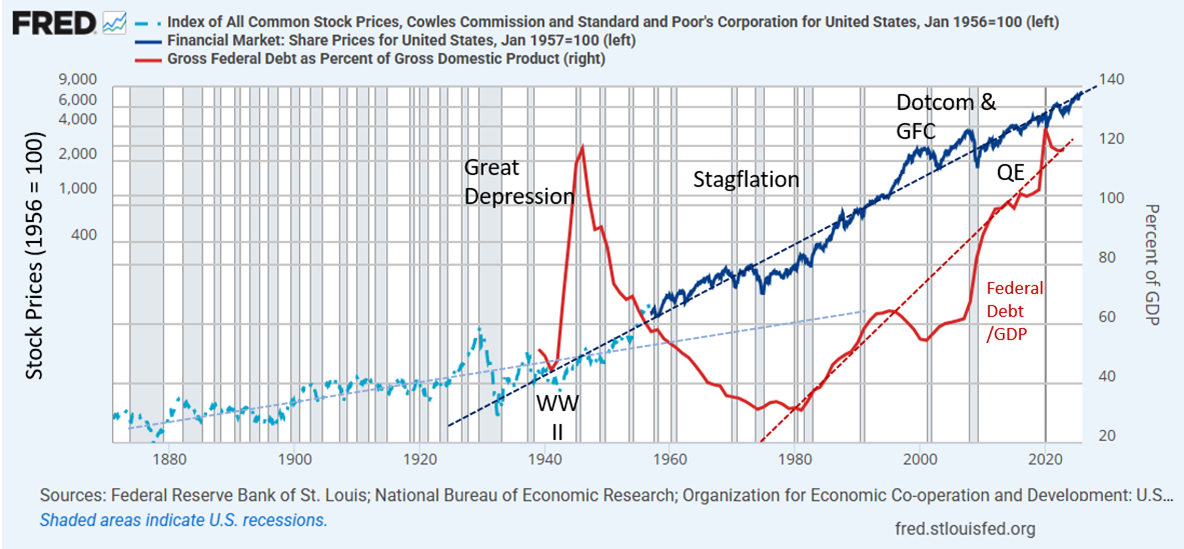
The book is enlightening about the financial instability during the preliminary evolution to the current financial system. Recessions, depressions, and bank failures were more common. Figure #1 is my attempt to capture the impact of financial evolution since the Civil War on the stock markets (log scale). The changes made during the Great Depression (1930s) created a stronger financial foundation, and recessions became less frequent. The end of World War II marked a major inflection point for stocks to rise at a faster rate. The taming of inflation in 1982, followed by the end of the Cold War, has extended this period of prosperity. I have concerns that policy changes being implemented now will result in unanticipated problems for decades to come.

The fact that the National Banking Acts [1864-1865] were both a present solution and source of future problems is not a unique phenomenon in financial history. Many financial innovations follow the same pattern. Sometimes unanticipated problems emerge within a few years, but usually they remain hidden for decades…
– Mark J. Higgins

Figure #1: Recessions and Stock Prices Since 1871

Source: Author using National Bureau of Economic Research, Cowles Commission, and Standard and Poor’s Corporation for the United States, retrieved from the Federal Reserve Bank of St. Louis (FRED)

The stock prices are shown in nominal values, but inflation and the devaluation of the dollar have played a role. The Gold Reserve Act of 1934 devalued the dollar, and President Richard Nixon ended international convertibility of the dollar to gold in 1971. Some of the growth in stock market prices was financed by rising debt, which now poses challenges to future growth.

The Power of Perspective

The Federal Reserve and Treasury may succeed in lowering short- and intermediate-term interest rates to stimulate economic growth and finance the growing national debt. The coming decade is likely to see inflation running a little hotter. Kenneth Rogoff stated in Our Dollar, Your Problem (2025) that he expects “a sustained period of global financial volatility marked by higher average real interest rates and inflation and more frequent bouts of debt and financial crises.” Ray Dalio wrote in Principles for Dealing with the Changing World Order – Why Nations Succeed and Fail (2021) that “The goal of printing money is to reduce debt burdens, so the most important thing for currencies to devalue against is debt (i.e., increase the amount of money relative to the amount of debt, to make it easier for debtors to repay).” I agree with these narratives.

There is a high risk in planning retirement based on the average performance of the stock market over the past one hundred years. Retirement planning involves settling on a realistic expectation for likely drawdowns during severe bear markets.

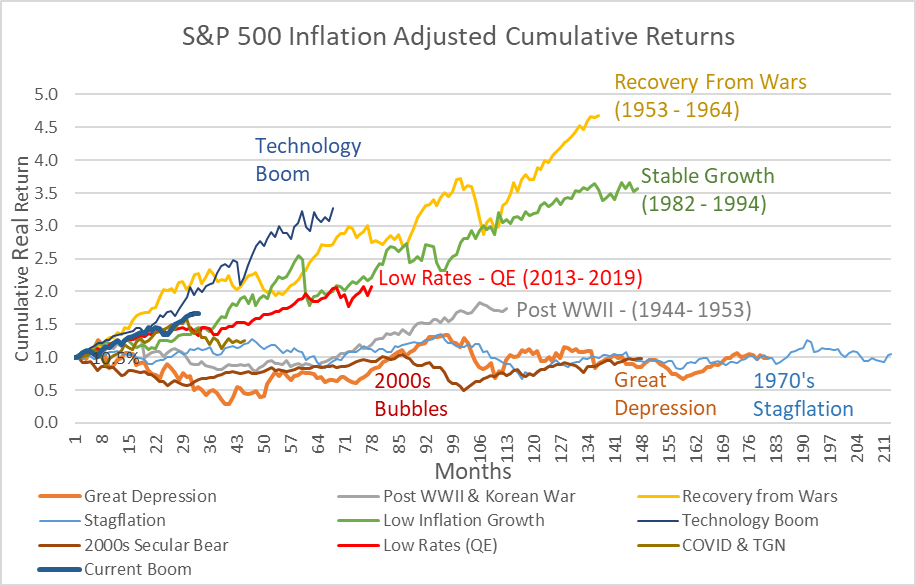
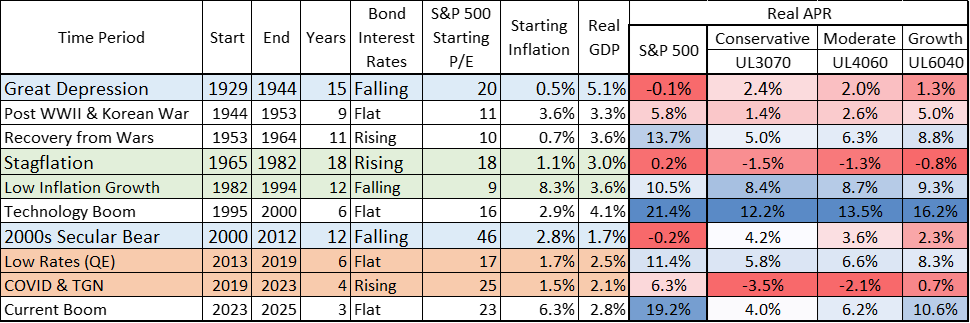
For this article, I estimated the inflation-adjusted returns of the S&P 500 for ten periods since 1929. Three periods covering 45 years saw no positive returns. Five periods covering 38 years produced the majority of the real returns since 1929. Sixty percent of these years (24 years) with high gains came during two time periods: 1) Peace time recovery period following the end of World War II and the Korean War, and 2) Stable Economic Growth following the stagflation of the 1970s and the end of the Cold War. The remaining periods (15 years) of high real stock market returns are during the periods of: 1) run-up to the Dotcom Bubble with high valuations, 2) low interest rates following the Great Financial Crisis when interest rates were suppressed, and 3) the past three years of rising equity valuations.

Figure #2 shows the inflation-adjusted cumulative returns. I don’t believe that the current three-year bull market (heavy blue line) has the foundation to extend more than a few years at most. Secular bull markets are rare, and cyclical bull markets last only three to five years.

Figure #2: S&P 500 Inflation-Adjusted Cumulative Returns

Source: Author Using MFO Premium fund screener and Lipper global dataset; St. Louis Federal Reserve (FRED) database

The information is shown in Table #1 along with some factors that influence stock market returns. Boom periods create excesses, which are followed by busts. High stock market returns are influenced by many factors besides economic growth, including population growth, valuations, wars, stability, uncertainty, geopolitical risk, globalization, technology, inflation, interest rates, and pandemics, among others. The blue-shaded periods covering 27 years (Great Depression & Bursting of Dotcom followed by the Great Financial Crisis) are when mixed-asset portfolios outperformed an all-equity portfolio. The two periods shaded green, covering 30 years (1970s Stagflation followed by low inflation with falling rates), are when mixed-asset portfolios performed about as well as an all-equity portfolio.

The two periods shaded burnt orange, covering 10 years (Low interest rates and rising interest rates), are when moderate mixed-asset funds underperformed the all-equity portfolio by five to eight percentage points. There were 27 years when a 40/60 portfolio outperformed the S&P 500 and 60/40 portfolio.

Table #1: S&P 500 Inflation-Adjusted Cumulative Returns

Source: Author Using MFO Premium fund screener and Lipper global dataset; St. Louis Federal Reserve (FRED) database

Some of the drivers of historical economic growth will have less of an impact in the future. The population of the U.S. has more than tripled since 1920, and growth has slowed. Gross federal debt as a percentage of gross domestic product has increased from 49% in 1940 to 119% today and is still rising. Starting equity valuations today (30) are higher than any of the ten periods and a headwind to stocks, while high starting yields are a tailwind to bonds performing well. Uncertainty does not favor stable economic or stock market growth.

The Advantages and Disadvantages of Cash

Those who have been fortunate to save and accumulate now have a very powerful buffer against panic – a cushion even with serious losses to ride it out. With conservative funds yielding 3.5% to 4%, cash is not trash. It provides liquidity for withdrawals and emergencies. Bear markets are typically less than one year, but the time to recover may take several more years. Keeping enough cash and safe investments to cover these two-to-five-year periods allows you ride out most bear markets.

The Tax Man Cometh!

I began studying financial planning two decades before retiring, while there was uncertainty about job security. It was a valuable lesson, especially about taxes. I switched contributions to Roth IRAs to reduce taxes during retirement. I was still overweight in Traditional IRAs, and performed Roth Conversions after retirement when my income was lower. It did raise my Medicare income-related monthly adjustment amount (IRMAA), which I am lowering by taking steady withdrawals from Traditional IRAs.

For diligent savers wishing to reduce their tax liabilities in retirement, they may want to plan ROTH conversions from TIRAs during market drops. In hindsight, I should probably have made smaller ROTH conversions more frequently while still working. I would have paid higher taxes while working, but avoided higher IRMAA premiums now.

Fools Rush In Where Angels Fear To Tread

Fear of missing out (FOMO) when the market is unexpectedly soaring often leads to investors being overcommitted to stocks. Humans are hardwired with the tendency to fear losses more than host positive feelings over the same gains, and it pushes them to sell at the bottom. In retirement, we need to be cognizant of the sequence of return risk that poor market conditions can have on our savings.

To resist their psychological urges, informed investors can raise cash while markets are high with a plan to deploy into stocks during drawdowns, so market losses are investment opportunities. Let yourself make a 5% urgency readjustment in stock/bond balance as a pressure valve when you are overwhelmed by fear (analogous to an occasional rich dessert on a diet). Over the past year, I permanently lowered my overall stock-to-bond target from 65% to less than 50%, but it has been creeping back up. Meanwhile, core bond funds have made close to 7% for the past year.

Closing

I don’t believe that the current bull market has a strong foundation to extend into a secular bull market. Periods with stable economic growth and high equity valuations tend to result in lower long-term equity returns as uncertainty increases. When investors perceive higher economic uncertainty, they tend to seek safety, leading to lower valuations as demand for stocks fall. Long-term rates are influenced by expectations for inflation and economic growth.

After researching income and alternative funds for the past several months, I decided to err on the side of safety. As bonds mature, I am investing the proceeds into a new rung on my ten-year ladder or conservative income-producing funds already in my Core TIRA. I have started building a small cash reserve. I find the risk-to-reward favors cash, but I look forward to opportunities to invest in an income-producing mixed-asset growth fund during market downturns.

Hope is not a good strategy.

A special thanks goes to my long-time friend Dave in Spokane, Washington. We began discussing investment books two decades ago on our two-hour trips to the nearest Costco. I continue to bounce investing ideas off him, and he provides wonderful insights.

Perpetual Income for Dummies

By Charles Lynn Bolin

A friend of mine asked me to write “Perpetual Income for Dummies,” covering a simple portfolio for a conservative investor that generates steady income to cover withdrawals. The objectives of the “Perpetual Income for Dummies” Portfolio are: 1) income of $40,000 for a $1M portfolio in 2016 that rises with inflation, 2) average ten-year annual return of 7%, and 3) minimize the drawdowns during the COVID and TGN bear markets. The unique part of this study is to estimate the income by year as a constraint in a self-constructed optimizer using Excel Solver.

I compare this portfolio with the Vanguard Wellesley Income Fund (VWIAX) and a Morningstar Conservative Tax-Advantaged Bucket #2 Portfolio. Each of these has advantages as part of an overall portfolio, but are not intended to be standalone portfolios.

I have been researching alternative and income funds for the past several months, looking for funds that produce steady income across many environments. For this article, I evaluated eight conservative alternative funds that had average yields of 4.2% over the past ten years. I evaluated bond funds in eight different Lipper Categories that have returned at least 4% annualized over the past ten years. These alternative and income funds have produced annualized returns of 4% to 5% over the past ten years. Income-producing mixed-asset funds are used to boost returns and contribute to income.

Risk Income

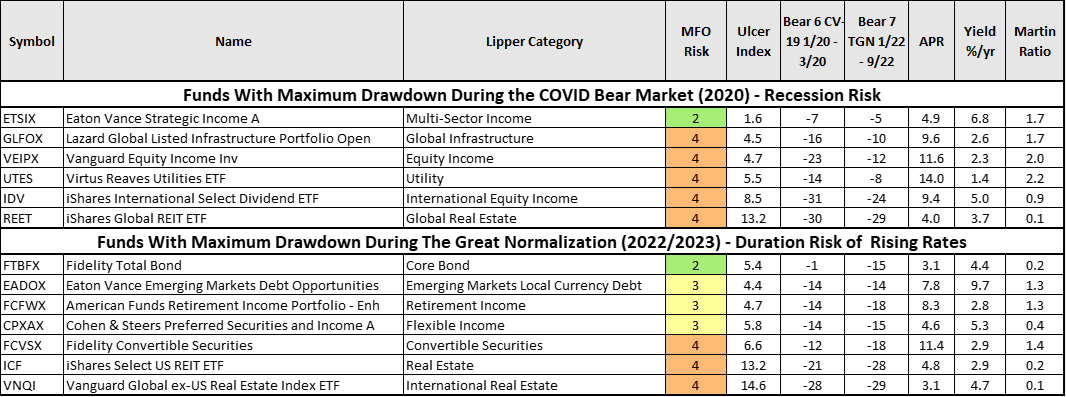
I look for funds that have the flexibility to do reasonably well in both the low-interest rate environment of the 2010s and a more volatile inflation environment since the COVID pandemic. The funds have more consistent and/or higher yields than traditional bond funds with less risk than equities. Most of the funds in the following table are too risky for a conservative investor such as myself. My preferred category is “Multi-Sector Income” because it has the flexibility to invest in multiple sectors and tends to have lower drawdowns. Eaton Vance Strategic Income (ETSIX) is included in the “Perpetual Income for Dummies” Portfolio for its low MFO Risk (Conservative), Ulcer Index, risk-adjusted returns, and high yield, among other reasons.

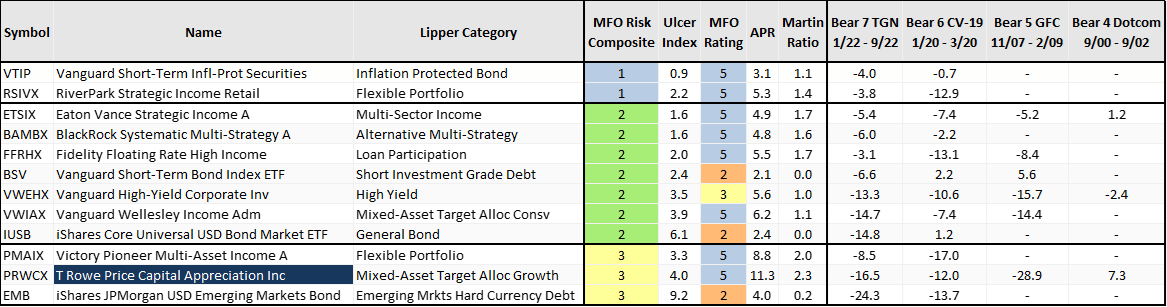
Table #1 contains examples of income-producing funds, including REITs, utilities, and equity income. Fidelity Total Bond (FTBFX) is a core bond fund shown as a baseline. The funds are divided based on whether their maximum drawdown occurred during the COVID Bear Market (2020), suggesting quality risk during a recession, or the Great Normalization (2022-2023), suggesting sensitivity to rising interest rates. They are sorted from lowest to highest risk. Most funds had moderate to high drawdowns in both periods. FTBFX performed well during the COVID bear market, but not the Great Normalization. For a long-term buy-and-hold portfolio, I want funds that have the flexibility to do reasonably well in both recessionary and inflationary environments.

Table #1: Risk Income – Ten Years

Source: Author Using MFO Premium fund screener and Lipper global dataset

Perpetual Withdrawal Rate

Here is a hat tip to YogiBearBull from the MFO Discussion Board. In the following table, I included the “Perpetual Withdrawal Rate” from Portfolio Visualizer. It is defined as, “… the percentage of portfolio balance that can be withdrawn at the end of each year while retaining the inflation-adjusted portfolio balance (percentage withdrawal). Perpetual withdrawal rate is specific to the time period and return path, so it is mostly useful as a relative comparison metric, not as an absolute value.”

In the companion article this month, “Hope Is Not a Good Strategy”, I cover why “there is high risk in planning retirement based on the average performance of the stock market over the past one hundred years.” In that article, I evaluate the inflation-adjusted stock performance for ten periods covering the past one hundred years. For more information on safe withdrawal rates, I refer you to the “PV – SWR, PWR (& SWRM)” thread posted by YogiBearBull on the MFO Discussion Board.

Overview

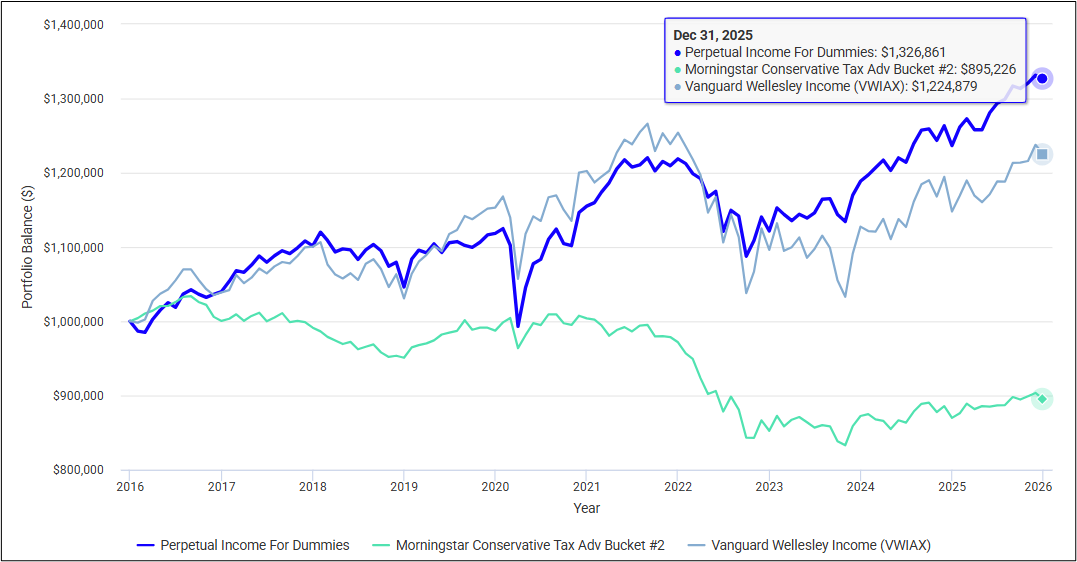
I used Portfolio Visualizer to analyze the three sub-portfolios. The link to Portfolio Visualizer is provided here. The results are very similar comparing the “Perpetual Income for Dummies” Portfolio to the Vanguard Wellesley Income (VWIAX) from 2016 through 2022. It outperforms VWIAX by quite a bit during the past three years, in large part because higher-yielding debt has performed better now that interest rates are higher. The “Morningstar Conservative Tax Advantage Bucket #2” Portfolio is all bonds for safe withdrawals covering the next three to ten years and has a lower income.

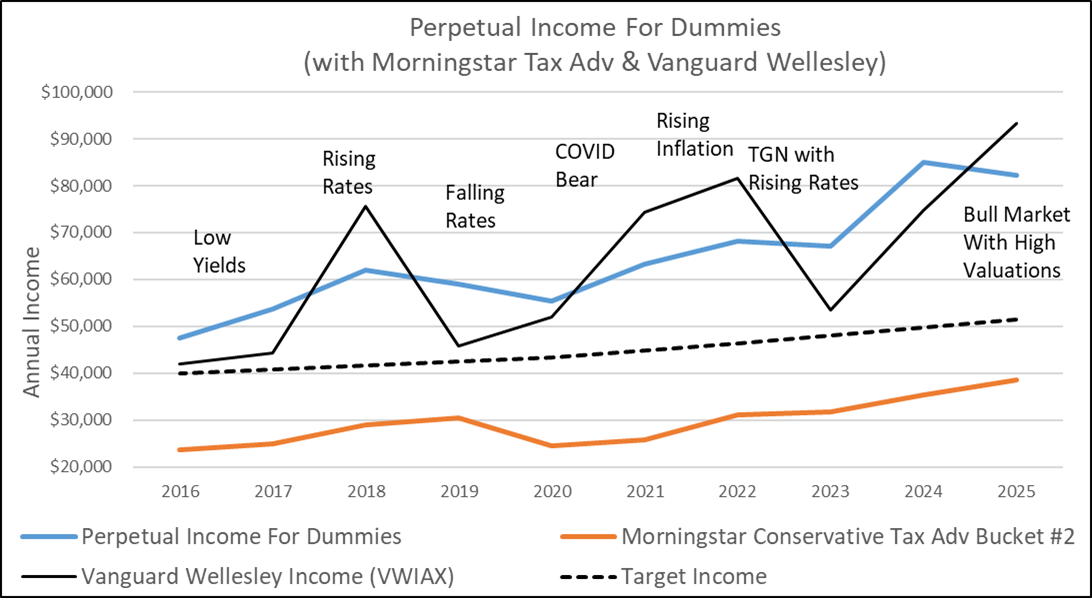
Let’s start with Figure #1, which shows the annual income of “Perpetual Income for Dummies” Portfolio (blue line) compared to the Vanguard Wellesley Income (VWIAX, solid black line), and the “Morningstar Conservative Tax Advantage Bucket #2” Portfolio (burnt orange line).  The dashed black line is the annual income constraint that increases with inflation. The “Perpetual Income for Dummies” Portfolio achieved the objective of having a steady income. The variability in annual income for VWIAX is mostly the result of capital gains distributions.

Figure #1: Portfolio Income – Ten Years

Source: Author Using Portfolio Visualizer

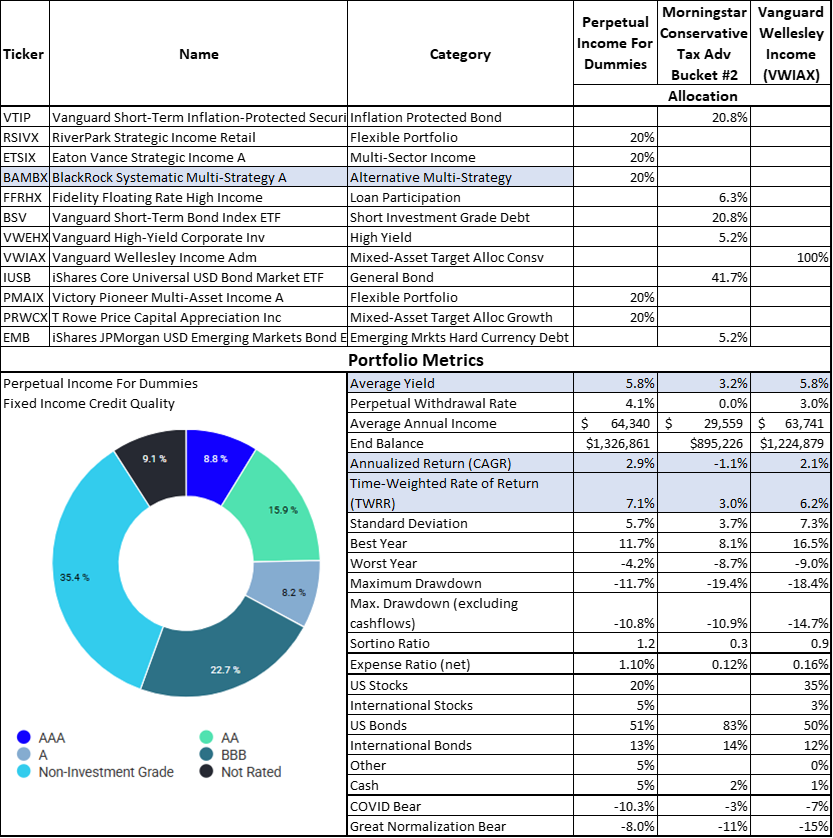
Table #2 compares the three portfolios for the past ten years. The assumptions include withdrawing 4% annually. The “Perpetual Income for Dummies” Portfolio has a higher return with lower drawdown than Vanguard Wellesley Income (VWIAX). It accomplishes this in part by having a lower allocation to stocks and a higher allocation to non-investment-grade debt. The funds are sorted by MFO Risk and Ulcer Index from the least risky to the highest. BlackRock Systematic Multi-Strategy (BAMBX) is an alternative fund.

The “Morningstar Conservative Tax Advantage Bucket #2” Portfolio is intended to be used for withdrawals when the stock market is low, and withdrawals taken from the Bucket #3 equity portfolio when the stock market is doing well. The intermediate Bucket is replenished from Bucket #3 when the stock market is high. The table assumes that all withdrawals come from the “Morningstar Conservative Tax Advantage Bucket #2” Portfolio. The overall portfolio strategy needs to be considered.

Table #2:  Portfolio Performance with 4% Withdrawals – 10 Years

Source: Author Using Portfolio Visualizer

My optimizer selected the T Rowe Price Capital Appreciation Income Fund (PRWCX), which is currently closed to new investors. For this article, I evaluated eighteen mixed-asset funds out of the sixty-one that I track that had the potential to have high risk-adjusted returns with an emphasis on income. FPA Crescent (FPACX) and Vanguard Wellington (VWELX) had similar performance to PRWCX. I like and own Vanguard Global Wellington (VGWAX), but did not include it in this evaluation because its inception date is less than ten years.

Figure #2: Portfolio Performance with 4% Annual Withdrawals – 10 Years

Source: Author Using Portfolio Visualizer

I selected the funds in “Perpetual Income For Dummies” Portfolio primarily on their performance for the past ten years, but also considered their lifetime performance as shown in Table #3.

Table #3: Fund Performance – 10 Years

Source: Author Using MFO Premium fund screener and Lipper global dataset

Perpetual Income for Dummies Portfolio

The objectives of the “Perpetual Income for Dummies” Portfolio are: 1) have income of $40,000 for a $1M portfolio in 2016 and increase for inflation, 2) have an average ten-year annual return of 7%, and 3) minimize the drawdowns during the COVID and TGN bear markets. It includes one multi-sector bond fund and one alternative multi-strategy fund, along with three mixed asset funds. I own shares in Victory Pioneer Multi-Asset Income (PMAIX) and two multi-sector income funds not included in the portfolio. The Lipper definitions are shown below for ETSIX and BAMBX.

Morgan Stanley Investment Management acquired Eaton Vance in 2021. ETSIX is available at Fidelity with no load or transaction fees. It is available at Vanguard with a load. I own two multi-sector income funds: PIMCO Income (PIMIX, PONAX) and FPA Flexible Fixed Income (FPFIX, FFIRX).

Eaton Vance Strategic Income (ETSIX): Multi-Sector Income Funds: Funds that seek current income by allocating assets among several different fixed income securities sectors (with no more than 65% in any one sector except for defensive purposes), including U.S. government and foreign governments, with a significant portion of assets in securities rated below investment-grade.

I own one alternative global macro fund, BlackRock Tactical Opportunities (PCBAX), in self-managed portfolios, but BlackRock Systematic Multi-Strategy (BAMBX) is probably a better selection for someone seeking income. I wrote BlackRock Systematic Multi-Strategy (BAMBX) vs BlackRock Tactical Opportunities (PCBAX) for the MFO September 2025 issue. The article compares them to Victory Pioneer Multi-Asset Income (PMAIX).

BlackRock Systematic Multi-Strategy (BAMBX), Alternative Multi-Strategy: Funds that, by prospectus language, seek total returns through the management of several different hedge-like strategies. These funds are typically quantitatively driven to measure the existing relationship between instruments and in some cases to identify positions in which the risk-adjusted spread between these instruments represents an opportunity for the investment manager.

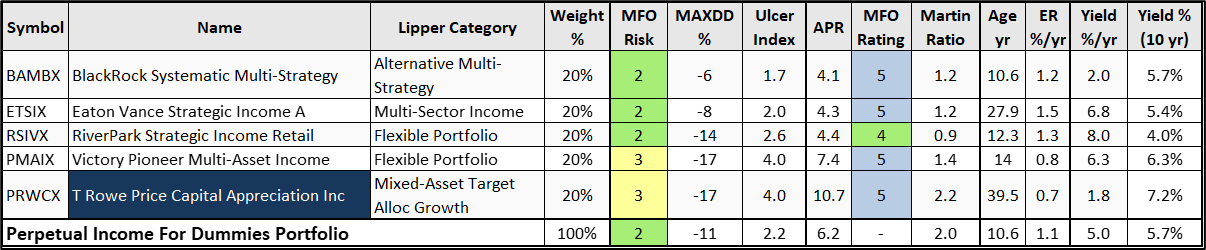
Table #4 contains the funds in the “Perpetual Income for Dummies” Portfolio from the MFO Premium Portfolio Tool, with the average yield over the past ten years from this study. Notice that the 10-year yield often differs significantly from the 1-year yield. Some funds have yields that fluctuate with the interest rate cycle, and some with the stock market cycle. The largest differences are usually the result of capital gains distributions.

Table #4: “Perpetual Income for Dummies” Portfolio – 10.6 Years

Source: Author Using MFO Premium fund screener and Lipper global dataset

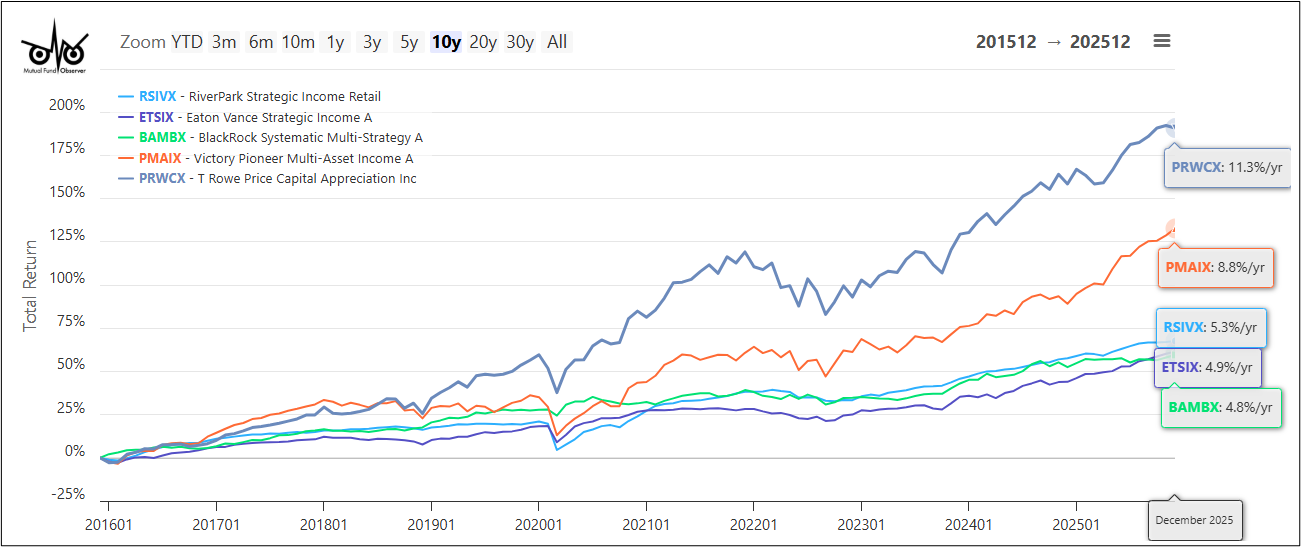
My intention is that the funds are buy-and-hold with occasional rebalancing. The funds have low correlations to each other, so that at least one fund should be doing relatively well in most market environments.

Figure #3: “Perpetual Income for Dummies” Fund Performance – 10 Years

Source: Author Using MFO Premium fund screener and Lipper global dataset

The “Perpetual Income for Dummies” Portfolio may be suitable for investors who are comfortable with alternative funds and investing in higher-risk debt. For those wanting to follow a more traditional approach, the other two portfolio options may be more suitable.

Vanguard Wellesley Income Fund (VWIAX)

I like the Vanguard Wellesley Income Fund (VWIAX), and it has been a core holding for years, but I switched to Vanguard Global Wellesley Income (VWYAX) because of its global exposure. VWIAX produces high income with a respectable total return. It sticks to debt-rated investment grade or higher.

Having one fund as part of a conservative TIRA is simple, and no rebalancing is required. The disadvantages are that yields can fluctuate, and you may have to sell in a down market if you require additional cash. Possible methods to overcome this are to use one or more bond funds and/or bond ladders that cover required minimum distributions if investment income falls short.

Morningstar Conservative Tax-Advantaged Bucket #2

Christine Benz wrote Tax-Sheltered Retirement-Bucket Portfolios for ETF Investors for Morningstar. I am a follower of her bucket approach and dividing an intermediate bucket into conservative and aggressive sub-portfolios. Her Bucket #2 that covers withdrawals for the next three to ten years is all bonds with equities located in Bucket #3. The objective of this bucket is safety with some income.

The Bucket approach to retirement portfolio planning isn’t designed to generate the best possible investment returns. It won’t—almost by definition. Instead, the Bucket strategy is geared toward real retirees, to help them source their needed cash flows regardless of what’s going on with their long-term holdings.

By maintaining an ongoing allocation to cash alongside a balanced portfolio, the Bucket approach enables retirees to withdraw funds from those liquid reserves when stock and/or bond values are in a trough. That allocation provides a psychological benefit, too, in that having cash on hand can help retirees cope with the volatility that will inevitably accompany their long-term holdings. In better market environments, retirees can source their cash flow needs from appreciated equity or bond holdings and not touch the cash.
Christine Benz

Note that the Morningstar Conservative Tax-Advantaged Bucket #2 Portfolio has a combined allocation of 15% in Loan Participation, High Yield, and Emerging Markets Hard Currency Debt. For Readers interested in more from Ms. Benz, I recommend How to Retire – 20 Lessons for a Happy, Successful, and Wealthy Retirement (2024).

Closing

It’s tough to make predictions, especially about the future.
– Yogi Berra

Which of the 3 choices is best? So, the answer is: It depends. It depends on your own comfort level with the risk/reward trade-off. Know thyself. Not just what you intellectually realize, but your actual behavior when it all hits the fan and markets are crashing, and you are down 15% or 20% or 25%, and the pit of your stomach yells, “Run!” Here are my own current calculations and adjustments to align with my risk tolerance.  Yours might be different.

Bear markets typically last nine months to a year and a half, while bull markets usually last three to five years. The risk to people depending upon their investments for income is when stock and/or bond market returns are low for extended periods of time. Most of the time, the aggressive sub-portfolio will be up, and withdrawals will come from it. I consider my Traditional IRAs to be in my intermediate Bucket (#2) because I have to take withdrawals from them, but have divided them into conservative and aggressive sub-portfolios with a combined allocation to stocks of less than 40%. Since the stock market is high, I have taken withdrawals from the aggressive TIRA sub-portfolio this year.

In essence, I use parts of all three portfolios discussed in this article. To protect against the downside risk of a secular bear market, I estimated conservative returns and withdrawals from the conservative TIRA sub-portfolio to ensure that it would last ten years. Longer-term, I would like to allocate a small amount to an income-producing mixed-asset growth fund in my conservative TIRA sub-portfolio. I believe the current risk-to-reward favors cash equivalents, and I am starting to build a small cash reserve for when opportunities arise. As bonds mature, I am investing the proceeds into a new rung on my ten-year ladder or conservative income-producing funds already in my Core TIRA. I am considering adding BAMBX as a diversifier.

Launch Alert: Disciplined Growth Investors Equity Fund

By David Snowball

Disciplined Growth Investors has launched their second mutual fund, the Disciplined Growth Investors Equity Fund (DGIQX). The fund is only nominally “new.” It technically launched on January 26, 2026, by way of a section 351 conversion (a sort of “in-kind exchange” that allows investors to avoid tax bills when exchanging one set of assets – say, appreciated stocks – for another, such as a fund or ETF) from a long-running limited partnership, Navigator Investors, LP. It opened to new investors on February 26 and will retain the partnership’s performance track record dating back to March 31, 1997. Over the ten years through December 2024, the Navigator fund returned 13.2% while its benchmark Bloomberg Mid-Cap Growth Index, returned 10.7%. Their flagship DGI Fund opened in 2011, and we profiled it in 2022. The Equity Fund is 100% stocks, while the balanced fund is 70% stocks, 30% bonds, with a mid-growth bias. The stocks in both portfolios are identical.

Two things to consider.

One, Disciplined Growth Investors, the balanced fund, is pretty successful and pretty distinctive.

The DGI portfolio has a far lower market cap and far greater growth tilt than its Morningstar peers. That has translated to both higher volatility (maximum drawdown, standard deviation, downside deviation) and higher absolute returns (by 270 bps annually since inception) than its peers. The equity portfolio is concentrated (44 names) and has low turnover (17%). It currently has 250% of the tech exposure of its Morningstar peers.

2025 was not kind to the fund’s strategy, which returned 3.5% to its peers’ 14%. That said, it has doubled the returns of its peers over the first couple of months of 2026 (7.3% versus 3.8%) and has outperformed the group over the past 3-, 5-, and 10-year periods, and since inception.  About 2025, our contact at the fund notes:

Marketers and market timers, we are not. Fred Martin started DGI in 1997, which was perhaps the worst time to start an actively managed, valuation-focused investment effort. The last 18 months have been similarly challenging for fundamentals-focused managers in a time of rampant speculation and overvaluation at the top end of the S&P 500, a dynamic even more extreme in the NASDAQ and Russell Mid Cap Growth indices. While we don’t jump and click our heels during times like these, we’ve experienced them before. As Fred often says, “It can’t continue, so it won’t.”

Two, their business model is old-school. The advisor’s website is … let’s call it “Spartan.” Most of the useful information is tucked away in a section called Geeks + Lawyers, then Literature. And you can only invest in the fund directly through the advisor; neither Schwab nor your financial advisor will get you in. Their argument is that this allows them to know their investors, to communicate directly with them, and to eliminate one layer of fees.

The minimum initial investment is $10,000 or $100/month with an automatic investment plan. The all-in fee is 0.85%.

You can find the prospectus here and the statement of additional information here.

New Year’s Resolution #2: Don’t Underwrite Yachts

By David Snowball

In celebration of an ancient tradition, recognizing that the new year starts with the arrival in March of spring, we wanted to share our second New Year’s resolution (after “Don’t Underwrite Lobotomies,” 1/2026).

“Yachts” have always been a curious flashpoint in the investor community. A half-century before J.P. Morgan sailed about in his floating palace, The Corsair (versions 1, 2, and 3), yachts were emblems of clueless avarice. The Gilded Age short-seller and noted wit William R. Travers supposedly uttered the question “but where are the customers’ yachts?” while looking at Wall Street men’s yachts in Newport harbor.

Fred Schwed, a stockbroker and professional trader bankrupted in the Crash of 1929, used the query as the title of his 1940 book, which enshrined it in the folk wisdom of Wall Street forever. Schwed’s amiably acidic text might be captured in three sentences that feel – 80 years on – painfully contemporary:

  1. Wall Street is built to deliver smooth, reliable income to the people selling advice, while handing the bumps, bruises, and blown‑up dreams to the people buying it.
  2. Almost nobody, pro or amateur, can actually see the future, but the whole ecosystem works very hard to act as if it can, turning “investing” into a pricey form of speculation dressed up in charts and lingo. (Hmm… most recently, “proprietary algorithms.”)
  3. The real problem, though, is that investors want to believe those stories, and that eagerness to be reassured is what keeps them quietly funding other people’s yachts instead of just compounding toward a modest boat of their own.

How many yachts have you funded? The figures in various international registries come to about 5,900 private superyachts (boats over 100’ in length) sailing today and another 600 slated to be finished by the end of 2026. That’s $11 billion a year now, projected to pop to $15 billion by 2030.

I teach in Old Main, whose (old) main hallway is about 160 feet long. There are about 1,700 private yachts bigger than the building I occupy.

The top 100 yachts, all over 85–90 meters (280–300 feet) and almost entirely owned by billionaires and royal families, typically have a full-time crew of 25-50 (including baristas and … umm, massage therapists), run their engines 24/7 (gotta keep the water out and the air dry even when the boss isn’t around), suck down 500-1500 gallons of fuel per hour when running at cruising speed, and are typically occupied from a couple weeks to a couple months a year.

Among the more notable yachts you’re paying for are Bezos and Brin’s boats.

Jeff Bezos, Amazon founder: Koru (and Abeona)

Koru, Jeff Bezos’ 127‑meter (about 418‑foot) sailing superyacht, was delivered in 2023 at a cost north of $500 million and annual upkeep around the mid‑eight figures. Steel hull and aluminum superstructure under three roughly 70‑meter masts, it accommodates about 18 guests with roughly 36–40 crew, and layers on the expected amenities: multiple Jacuzzis, a pool, and a warm, wood‑heavy interior pitched as “timeless” rather than flashy. The name “Koru,” taken from Māori for a fern spiral, is meant to evoke new beginnings and growth.

Abeona is Bezos’ 75‑meter dedicated “shadow vessel” for Koru. At roughly 1,900 gross tons, with an estimated value around $75–100 million, Abeona exists to haul the infrastructure of billionaire leisure: a helipad, tenders and smaller boats, toys, extra fuel and stores, space for luxury vehicles, and berths for a crew typically quoted north of twenty and up toward the 30–35 range when fully staffed. In practice, she is the floating logistics platform that makes Koru’s serene imagery possible, absorbing much of the cost, complexity, and labor that never appears in the brochure shots.​

Source New York Post, August 2024

How centibillionaires stay centibillionaires: Amazon announced 27,000 layoffs in 2022-2023, another 14,000 in October 2025, and 16,000 more announced January 28, 2026. CEO Andy Jassy frames it as “removing bureaucracy” while Amazon pours $125 billion into AI infrastructure.

Bezos doesn’t do irony

In 2010, Jeff Bezos addressed Princeton’s graduating class with a meditation on gifts versus choices. “Cleverness is a gift, kindness is a choice,” he told them, recounting a childhood lesson from his grandfather: “One day you’ll understand that it’s harder to be kind than clever.” He closed with a series of rhetorical questions: “Will you be clever at the expense of others, or will you be kind?… When it’s tough, will you give up, or will you be relentless?… Will you be a cynic, or will you be a builder?”

Sixteen years later, the answers are in. Clever? Undeniably. Kind? The 57,000 Amazon employees laid off since 2022 might have thoughts. Builder? Of monopolies, certainly. Relentless? In tax avoidance and union-busting, absolutely.

“In the end, we are our choices,” Bezos concluded. “Build yourself a great story.”

He built himself a yacht instead. Two, actually.

In February 2026, about three weeks ago, as we write this, Bezos ordered the Washington Post to fire one-third of its staff, including 300 journalists. Among them: Caroline O’Donovan, the reporter who covered Amazon. The entire Middle East desk. The sports section. Most of the Metro desk, down from 40 reporters to 12. Former executive editor Marty Baron called it “a case study in near-instant, self-inflicted, brand destruction” and blamed it directly on Bezos’s fear of Trump retaliation against Amazon and Blue Origin.

Two days before the layoffs, Defense Secretary Pete Hegseth visited Blue Origin’s spaceport. Bezos called it a “huge honor” and praised Hegseth for “building The Arsenal of Freedom.” The $2+ billion Space Force contract was presumably worth the cost: 300 journalism careers, the credibility of a 150-year-old institution, and whatever remained of the promise that “the paper’s duty will remain to its readers and not to the private interests of its owners.”

Sergey Brin, Google co-founder: Dragonfly

The latest Dragonfly is a new 142‑meter (about 466‑foot) yacht, delivered in late 2024. Public estimates tag this Dragonfly at roughly 9,000–9,500 gross tons and around $450 million in build cost, with the usual long‑range, full‑displacement profile: multiple decks, pools and spas, extensive guest accommodations, and a private‑resort level of onboard amenities and technology. Brin’s earlier puny 74‑meter yacht of the same name has been reported as for sale, in case you’re interested.

How centibillionaires stay centibillionaires: Google’s founding motto, long discarded, was “do no evil.” In late December 2025, Sergey Brin dissolved or relocated 15 California limited liability companies in a span of 10 days. Among them was the entity managing Dragonfly. The move wasn’t about sailing to Nevada, yachts don’t do that, but about legal domicile. California was considering (i.e., did not enact) a one-time 5% tax on residents’ worth over $1 billion, and Brin, worth $267 billion, wasn’t interested in contributing $13 billion toward healthcare and K-14 education in the state that nurtured Google from dorm-room project to global surveillance engine.

This is the same Sergey Brin whose company has spent 2025 “eliminating bureaucracy” through a rolling series of workforce reductions. Google cut hundreds in January across hardware and engineering. More hundreds in February from HR and Cloud divisions. In August, the company announced it had eliminated 35% of its managers. Executives call the reductions “quite successful” and promise to “continue it.”

The juxtaposition is stark: Brin’s yacht management company flees to Nevada to avoid a hypothetical tax while Google employees are being offered “voluntary” exits and told the company needs to “be more efficient as we scale up so we don’t solve everything with headcount.”

And don’t even start poking around Mark Zuckerberg ($300 million Launchpad plus Wingman) and the Meta mess.

Here’s what we need to remember: We paid for those yachts. Not directly – there was no line item on your credit card statement for “Dragonfly hull maintenance” or “Koru champagne fund.” But every Gmail you’ve sent, every search query you’ve typed, every YouTube video you’ve watched has generated data. That data gets packaged, analyzed, sold to advertisers, and used to build monopolies. The proceeds funded Brin’s fortune. The yacht is just the most visible manifestation of an extraction you never consented to and likely never realized was happening.

The tech billionaire’s playbook is remarkably consistent:

  1. Offer a “free” service (Gmail, Facebook, Amazon’s subsidized shipping)
  2. Harvest user data, attention, and labor
  3. Extinguish alternatives (think: small shops in your town), build a monopoly market position
  4. Extract extraordinary profits
  5. Buy yachts, flee taxes, lay off workers
  6. Repeat

These aren’t moral actors. They’re not your friends. The relationship is extractive, not reciprocal. You provide data, attention, purchasing patterns, social connections, and in return you get… a service you didn’t realize you were paying for.

The Wall Street Journal, of all people, is sounding the alarm about this extractive imbalance. Carol Ryan lays out the argument:

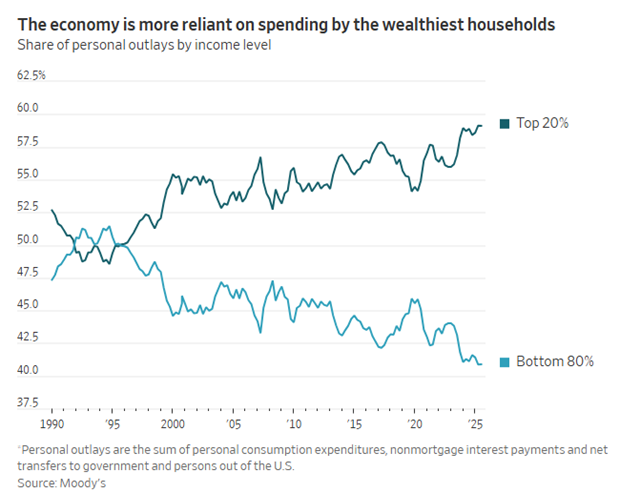
But debate about how much tax billionaires pay is likely to grow as America’s fiscal situation deteriorates and its wealth gap widens. Data from the Federal Reserve shows that only the richest 1% of households have grown their share of overall U.S. wealth since 1990. Their share hit a record 32% in the third quarter of 2025, equivalent to $54.8 trillion …

Gains made by the billionaire class, the very top 0.1% of households and a subset of the 1%, have eclipsed the merely extremely rich.

The impacts of this are visible in booming sales at businesses that cater to the ultrarich. Wealth concentration is so intense that it is even causing a divergence among luxury-goods companies: Brands such as Cartier or Hermès that cater to the super wealthy are soaring, while sales at labels that rely on affluent middle-class consumers are slack.

Meanwhile, the bottom half of American households have lost ground. (“Billionaires’ Low Taxes Are Becoming a Problem for the Economy,” WSJ.com, 2/18/2026)

The Journal offers a striking visual capture of an economy increasingly run for the benefit of the ultrarich.

What you can do about it

As a guy with 10 Gmail accounts (six of which are “burner” accounts used to annoy marketers) and “The Repair Shop” streaming on Amazon Prime, I’m not here to pick on you. Amazon’s convenience is real. Gmail works remarkably well. But transparency and respect have value too, and there are alternatives worth considering. The goal isn’t purity; it’s rebalancing the relationship so you’re not quietly funding extraction you never consented to.

Extract yourself from the Amazon ecosystem

  • Create a circuit-breaker for your shopping impulse:  Never click “buy now.” Put stuff in your cart, then give yourself a 24-hour cooling-off period. Don’t save payment information. Make yourself type in the d**mned credit card details each time. The friction helps break the “one-click” hypnosis.
  • Consider alternative retailers:
    • Bookshop.org shares profits – $45,615,057.08 so far – with independent bookstores. When you order through them, a portion goes to the bookstore you designate, like The Atlas Collective in Moline, Illinois, River Lights in Dubuque, Iowa, or any other shop on their network. (And yes, you pay for shipping because they pay for shipping.) As an aside, you do not own any of the content on your Kindle; you merely pay for access rights which Amazon can – and frequently does – revoke.
    • UncommonGoods, a B-corp, offers unique items from small makers and artisans, with a focus on actual craftsmanship rather than algorithm-optimized commodity junk. They’ve so far contributed $3.1 million to groups from the International Rescue Committee to American Forests. (Work this choice through: pay for the yacht, pay to feed a child whose home has been destroyed. Your choice.)
    • Your actual town: Walk into an actual store. Talk to an actual human. Yes, you might pay 10-15% more. Yes, you won’t get overnight shipping. But you also won’t be training Amazon’s AI on your purchasing patterns or subsidizing the next round of warehouse worker layoffs.
  • The “free shipping” trap: That’s not free. You’re paying $140/year for a Prime membership, or you’re paying in data harvest and algorithmic manipulation. Make informed choices about whether the tradeoff is worth it.

Extract yourself from the Google ecosystem

  • ProtonMail (proton.me) offers genuinely private email with end-to-end encryption. Swiss-based, funded by users, not by selling your data. Chip and I are migrating there, bit by bit. Free tier available; paid plans start around $4/month.
  • Privacy-first browsers and search engines:
    • DuckDuckGo doesn’t track searches or build profiles
    • Brave Browser blocks trackers by default
    • Firefox with privacy extensions gives you control over data collection
  • The convenience calculation: Yes, Gmail integration with Google Calendar and Drive is smooth. But that smoothness costs you comprehensive surveillance of your communications, contacts, and calendar. ProtonMail now offers calendar and drive functionality—slightly less polished, but with your privacy intact.

Extract yourself from the Meta ecosystem

This one’s harder because Facebook has achieved something close to utility status for many communities, especially outside major metros. But consider:

  • Do you actually need Facebook? Many people keep accounts “to stay in touch” while acknowledging they haven’t posted or actively engaged in years. If that’s you, deactivate and see what you lose. Probably less than you think. I have one of the very earliest public Facebook accounts and manage to visit it about once a year.  
  • Instagram: Owned by Meta. Same surveillance infrastructure, by which I mean: every photo you upload gets analyzed by AI to identify faces, objects, locations, and emotional content. Every post you like, every account you follow, every ad you pause on for three seconds longer than average gets logged, analyzed, and fed into a model that predicts your behavior, political leanings, purchasing intent, relationship status, and psychological vulnerabilities. That profile gets packaged and sold to advertisers, political campaigns, and anyone else willing to pay. The photos are yours; the data extracted from them belongs to Meta. Consider whether aesthetic dopamine hits are worth the extraction.
  • WhatsApp: Also, Meta-owned. Signal offers equivalent functionality with genuine end-to-end encryption and no Meta data mining.

Support actual journalism

The information ecosystem is collapsing because we’ve accepted “free” news subsidized by surveillance capitalism. Consider:

  • Subscribe to real news sources: Your local newspaper (if one still exists, Pittsburgh is about to lose its historic daily Post-Gazette). The New York Times. The Wall Street Journal. The Atlantic, launched in 1857 and doing some stunningly good reporting online today. Nautilus, an amazing new publication in print and online, for science and nature writing. Heck, chip in to support pubs that are useful but don’t force you to contribute: The Conversation, a platform on which active researchers translate what they’re passionate about into language that’s meaningful to you, or … oh, dare I suggest MFO. Publications that employ actual reporters doing actual reporting. And, as a matter of full disclosure, all are publications which Chip and I (not MFO, except for the WSJ) pay to read.
  • Recognize the hidden cost of “free”: When you get news from Facebook or Google News, you’re not getting neutral information delivery. You’re getting algorithmically selected content optimized for engagement (read: outrage) and advertiser revenue. The editorial judgment has been replaced by machine learning trained on what makes you click, not what helps you think. That’s quite apart from the fact that most of this content, created by AI or by some poor soul being paid $0.03 a word or a penny a click, inspired Cory Doctorow’s screed, Enshitification: Why Everything Suddenly Got Worse and What to Do About It (2025, and the link goes to Bookshop.org).

And what about your beloved iPad?

Apple is not as evil as, say, Meta. Tim Cook, to his credit, does not own a yacht, but the Apple ecosystem is probably more addictive and harder to escape. The company’s business model, basically selling expensive hardware rather than selling you to advertisers, creates better privacy incentives than Google’s, but they’re still collecting data: device identifiers, location, app usage, and what you search for in the App Store. Research from Trinity College Dublin found iPhones send data back to Apple every 4.5 minutes on average, even when you’ve explicitly opted out of data sharing. The real genius is the ecosystem lock-in: iCloud, iMessage, AirDrop, and seamless device handoffs are designed to make leaving painful, which is why my students lament, “My whole life is in iCloud, I can’t stop using an iPhone!”

Two things to think about: First, go to Settings → Privacy & Security and actually look at what you’ve allowed. Location services, ad tracking, analytics sharing, most of it’s on by default. Second, consider whether you’re paying Apple $10/month for iCloud storage because you need it or because their free tier (5GB) is deliberately stingy. External hard drives still exist.

The bottom line: it’s not about abstinence

Here’s the thing about this advice: it’s not all-or-nothing.

Suggesting you completely abandon Amazon, Google, and Meta in 2026 is like suggesting you stop using electricity in 1926. These companies have achieved something close to infrastructure status. For many people, especially folks outside major metros (I spent six blissful years in Durant, Iowa, population 1800), especially with limited mobility or time, Amazon genuinely solves real problems. Gmail works. Facebook connects people to distant relatives and old friends in ways that matter.

The goal isn’t digital monasticism, though that sounds kind of cool. It’s informed, incremental rebalancing.

Think about it like diet advice. Nobody’s telling you to never eat sugar or fat. But when you understand that Coca-Cola spent decades funding research to shift blame for obesity away from sugar toward dietary fat, you make different choices. You don’t quit soda entirely (though some people do), but you stop treating it as a harmless default beverage. You recognize the manipulation and adjust accordingly.

Same principle here:

  • You don’t have to quit Amazon entirely. But maybe check Bookshop.org first for books, or walk into The Source in Davenport instead of clicking “buy now.” Friction is your friend.
  • You don’t have to abandon Gmail immediately. But maybe create a ProtonMail account for sensitive communications. Use it for finances, health records, anything you’d rather not have Google’s AI training on.
  • You don’t have to delete Facebook if it’s genuinely connecting you to people who matter. But maybe turn off location tracking. Decline “personalized” ads. Recognize that every interaction is data being packaged and sold.

The broader point is about power and accountability. Right now, we have almost none. These companies have structured themselves as intermediaries between you and… everything. Email. Communication. Shopping. News. Social connection. They’ve inserted themselves into the infrastructure of daily life, then built fortunes by harvesting and monetizing your behavior.

You can’t fix that alone. This requires antitrust enforcement, privacy legislation, and a fundamental restructuring of how we think about digital services. But while waiting for that (and don’t hold your breath—these billionaires are very good at buying political parties as much as yachts), you can make incremental changes that reassert some agency over your own data, attention, and dollars.

The yachts will keep sailing. But maybe, just maybe, you don’t have to be the one paying for the fuel.

Briefly Noted . . .

By TheShadow

Updates

The Renaissance at Matthews Asia continues. After a period of considerable disarray, one of the firm’s founders, Mark Headley, returned from retirement to become CEO. On February 13, 2026, the firm announced that founders G. Paul Matthews, who founded the firm in 1991, and Mark Headley will acquire a controlling ownership interest in the firm. The buyback isn’t just a financial transaction; It’s a statement that the firm believes its problems were governance-related rather than market-related (the “Asia is dead” thesis). Winnie Chwang, Michael J. Oh, CFA, and Inbok Song “ceased to be” managers of three Matthews funds. Tiffany Hsiao’s profile and responsibilities were increased. CEO Mark Headley resumed work as a manager of the Pacific Tiger fund and ETF. Kathy Xu is joining Matthews from APG Asset Management, a Dutch firm with nearly 700 million Euros under management, to co-manage Pacific Tiger with him.

Briefly Noted . . .

AQR funds are reorganizing four of its funds into other existing funds: AQR Large Cap Momentum Style fund into the AQR Large Cap Multi-Style fund; AQR Small Cap Momentum Style fund into the AQR Small Cap Multi-Style fund; and AQR International Defensive Style fund and the AQR International Momentum Style fund into the AQR International Multi-Style Fund. Each reorganization is expected to close during the second calendar quarter of 2026.

Launches and Reorganizations

BlackRock has filed to offer the iShares Flexible Equity Active ETF, a global long/short all-cap equity fund. The portfolio relies heavily on quantitative models and artificial intelligence to dictate much of its shape, a reliance BlackRock explicitly flags as a principal risk. About the only meaningful restriction on the managers’ freedom is that the fund will always maintain a positive net exposure to equities (in effect, avoiding a net-short position). There’s also a provision allowing for currency hedging and real asset exposure.

The managers will be Rick Rieder (lead manager at the three-star BlackRock Strategic Income Opportunities Fund), Randy Berkowitz, CFA (first manager on a series of three-star “Active” ETFs for BlackRock), and Russ Koesterich, CFA, JD (lead manager at the four-star BlackRock Global Allocation Fund).

Bridgeway Funds is reorganizing three of its mutual funds, Small Cap Value, Aggressive Investors 1, and Ultra Small Company Market funds into the following exchange traded funds: Bridgeway Select Small-Cap Value, Aggressive Investors, and Ultra-Small Company Market ETFs, respectively. If approved by the shareholders of the target funds, the reorganization is expected to take effect during the third quarter of 2026.

Pending board approval, Cohen & Steers Future of Energy Fund is being reorganized as an ETF. The conversion is currently expected to occur during the second or third quarter of 2026.

Ritholtz Wealth has registered to offer the Goaltender ETF (GTND). It’s a “trend-following strategy” whose portfolio can shift once a month. Using a fairly simple metric, the fund becomes more or less aggressive with each month’s market action. The firm has run the same discipline in an asset-allocation strategy; we can find no public record of the strategy’s performance. The strategy is designed to complement a core equity holding and is a tool for managing investor (bad) behavior during market extremes.

Sterling Capital Short Duration Bond and Ultra Short Bond funds are being reorganized into the Sterling Capital Short Duration Bond ETF and Sterling Capital Ultra Short Bond ETF, respectively. Each reorganization is expected to occur on March 30. Shareholders of the mutual funds are not required to approve the reorganization.

Small Wins for Investors

Allspring Special Small Cap Value Fund is reopening to new investors on or about March 27th. The $3.6 billion fund closed to new investors on November 14, 2018, and has seen net outflows pretty much monthly since COVID. Below-average return and risk over the past five years, low turnover, high active share, quality-tilted portfolio, stable management team, and high insider ownership.

Boston Partners Global Investors, Inc. has contractually agreed to lower its investment advisory fee to 1.60% of the Boston Partners Long/Short Equity fund’s average daily net assets for the. Prior to March 1, 2026, the Fund’s investment advisory fee was 2.25%. The Adviser has also agreed to waive its advisory fee and/or reimburse expenses in order to limit total annual fund operating expenses (excluding short sale dividend expenses, brokerage commissions, extraordinary items, interest, or taxes) to 1.70% or 1.95% of the average daily net assets attributable to the fund’s Institutional class shares or Investor class shares, respectively.

Vanguard has lowered expense ratios for 84 mutual fund and exchange-traded share classes across 53 funds, amounting to nearly $250 million in fee reductions in 2026. Vanguard’s product lineup across all asset classes and styles now has an average expense ratio of 0.06%. The expense reductions were effective immediately.

Old Wine, New Bottles

Effective on or after May 12, 2026, the AQR Global Equity Fund will be renamed AQR Global Fund.

Effective on or about April 28, 2026, BlackRock Diversified Equity Fund will be renamed BlackRock Diversified Equity Alpha Fund. Because “Alpha” is, you know, manly.

Effective April 13, 2026, Eaton Vance Greater India Fund will change its name to Eaton Vance India Fund, which, I suppose, is more euphonious than Eaton Vance Lesser India Fund.

Effective March 1, 2026, the Harbor Convertible Securities Fund was renamed Harbor Ares Systematic Convertible Securities Fund. The change reflects a renaming of the fund’s sub-advisor. On the same day, Harbor Scientific Alpha High-Yield ETF was renamed Harbor Ares Systematic High Yield ETF, and Harbor Scientific Alpha Income ETF became Harbor Ares Systematic Multi-Sector Income ETF.

Effective on or about March 4, 2026, Janus Henderson Absolute Return Income Opportunities Fund will be renamed Janus Henderson Low Duration Multi-Sector Income Fund.

Effective on February 26, 2026, the LDR Real Estate Value-Opportunity Fund changed to LDR High Income Realty Fund.

Matthews Asia has proposed renaming two of their funds: Matthews China Discovery Active ETF will become Matthews China Innovators Active ETF, and Matthews China Small Companies Fund will become Matthews China Innovators Fund. The latter fund will have the ability to invest across all market capitalizations but will, they aver, continue to focus on smaller companies.

On May 1, 2026, Six Circles Tax Aware Ultra-Short Duration Fund will become Six Circles Tax Aware Intermediate Duration Fund. Its portfolio duration will spike from under one year to something in the 3-8 year range.

The Tema Monopolies and Oligopolies ETF, which has not yet launched, had a change of heart and now hopes to be known as the Tema International Durable Quality ETF.

On or about April 17, 2026, T. Rowe Price International Disciplined Equity Fund will be reorganized into the T. Rowe Price Overseas Stock Fund.

On July 24, 2026, the Voya Balanced Income Portfolio, which is currently available only through “separate accounts of insurance companies serving as investment options under variable contracts or by qualified pension or retirement plans,” will be converted to Voya Balanced Income Fund, whose “A” share class will be available to anyone.

Off to the Dustbin of History

On or about March 31, 2026, iMGP Polen Capital Emerging Markets ex-China Growth ETF will cease operations, liquidate its assets, and prepare to distribute proceeds.

KraneShares Global Luxury Index ETF and KraneShares European Carbon Allowance Strategy ETF are being liquidated on March 13, 2026.

Matthews Asia Growth will be merged into Matthews Asia Innovators Fund on or about May 12, 2026.

Nuveen Sustainable Core ETF turned out to be unsustainable and will be liquidated on April 6, 2026. Nuveen Dividend Growth ETF and the Nuveen Winslow Large-Cap Growth ESG ETF will exit the same day.

Westwood LBRTY Global Equity will be liquidated on or about March 6.